Reinstate compared with vendor and file sync
Reinstate is a continuity layer for coding-agent work: stable v0.5.1 indexes
local sessions from eleven agents without configuration and syncs same-vendor
Claude Code and Codex sessions through encrypted, user-owned storage. It
complements native agent features, full coding environments, session browsers,
and Git instead of replacing them.
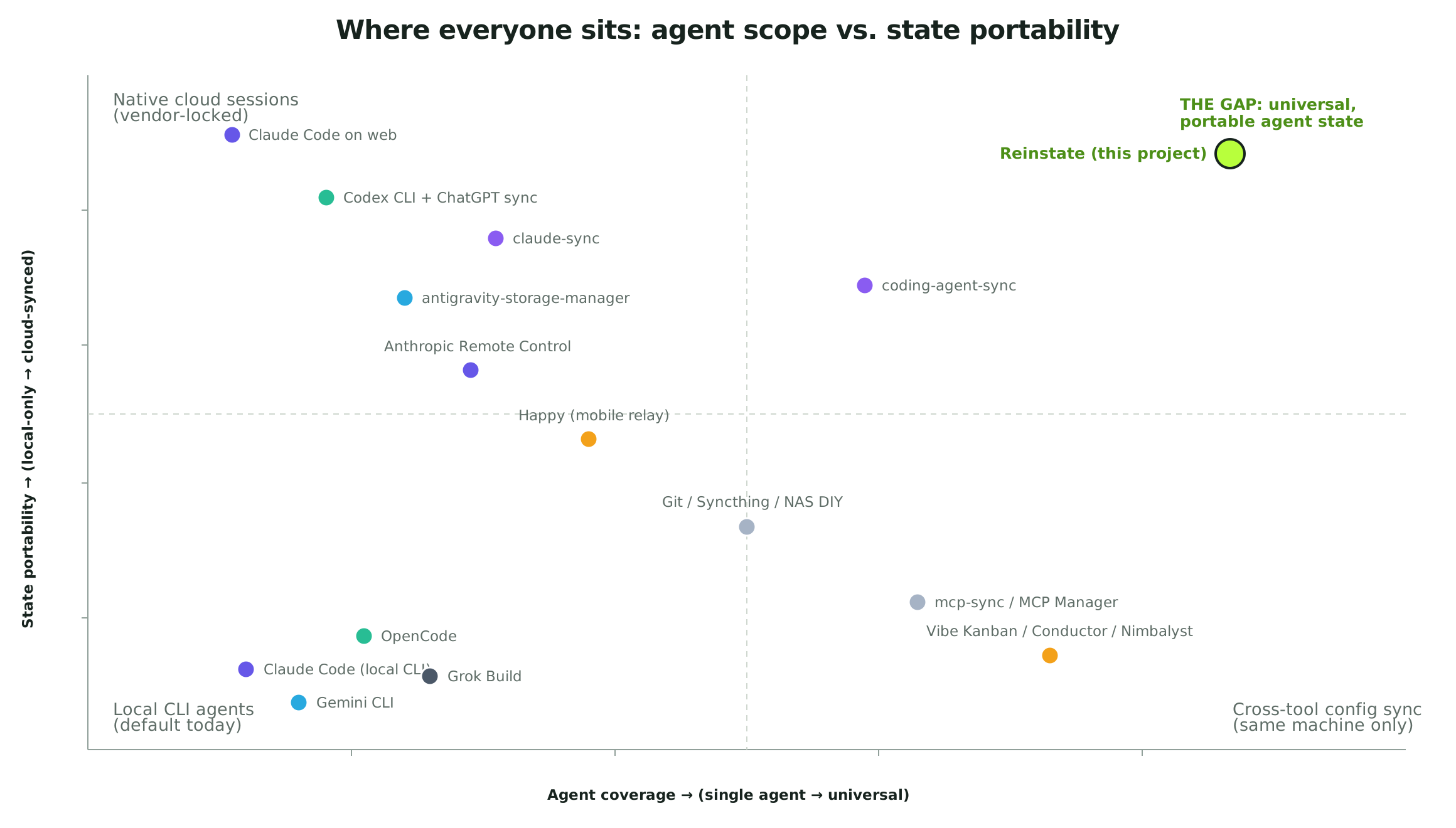
Feature matrix
| Capability | Reinstate | Native agent features | General-purpose file sync |
|---|---|---|---|
| Agent scope | Claude Code and Codex, same-vendor resume | One vendor ecosystem at a time | Any selected files, without agent semantics |
| Local discovery | Claude Code/Codex full; Gemini CLI/OpenCode read-only | Vendor-specific | Filename/path only |
| Storage ownership | Your S3-compatible bucket | Vendor-defined | User-selected |
| Remote payload encryption | age-encrypted locally before upload | Vendor-defined | Depends on the chosen tool and setup |
| Cross-OS project paths | Canonical project IDs and structural path remapping | Usually internal to the vendor workflow | Manual path and layout handling |
| Credential handling | Known credential artifacts are hard-excluded | Vendor-defined | User-maintained exclusions |
| Transfer model | Full immutable snapshots in Phase 1 | Vendor-defined | File-level |
| Cross-agent handoff | Structured handoff into a new Claude or Codex session | Outside Reinstate’s native-resume model | No transcript semantics |
| MCP, skills, plugins, settings | Universal desired-state configuration is roadmap work | Vendor-local capabilities | Manual file selection |
This table describes Reinstate’s verified product scope, not a ranking guarantee. Vendor and file-sync behavior changes, so evaluate those products against their current documentation.
How does Reinstate differ from native agent features?
Native session features stay inside their vendor’s ecosystem. Reinstate’s Phase 1 differentiator is neutral storage plus structural path remapping for same-vendor Claude Code and Codex sessions. Phase 2 adds a configless local index and same-vendor native launch plans. Phase 3 adds verified resume. Phase 4 adds explicit structured handoff. Universal configuration remains later work.
Reinstate does not claim to natively resume a Claude transcript inside Codex.
How does Reinstate differ from single-agent sync tools?
Single-agent utilities can solve a focused vendor-specific transfer problem. Reinstate implements separate Claude Code and Codex adapters behind one continuity model, keeps native resume same-vendor, and treats Windows ↔ macOS project-path remapping as a first-class concern.
How does Reinstate differ from config-only tools?
Config-only tools address settings rather than session continuity. Reinstate’s current release scope is local session continuity plus encrypted session sync; universal agent configuration is planned for a later phase.
The planned layer covers MCP servers, skills/instructions, hooks/loops, plugins, marketplaces, and safe settings. It translates desired state through verified per-harness adapters, reports unsupported fields, and keeps credentials local.
How does Reinstate differ from generic file sync?
Generic file sync moves bytes. Reinstate understands vendor session locations, canonical project identity, structural paths, active-agent safety, and known credential exclusions. A manual setup must recreate those safeguards itself.
How does Reinstate differ from Git?
Git remains the source-code history. Reinstate moves coding-agent session context and does not replace commits, branches, remotes, or repository sync.
Positioning one-liner
Vendor sync owns one agent. File sync owns bytes. Reinstate owns coding-agent continuity — sessions first, verified environments and explicit handoffs later — across agents and machines.